
Your House Within
Strategies are great.
But why aren't they helping?
People don’t usually come to counselling asking for a map. They don’t ask how their emotions work or say they want to understand what is happening in their emotional worlds.
What they ask for is a strategy. A tool. Sometimes a hack or a trick. The latest thing nobody has told them yet.
They say: I’ve tried journalling. I’ve tried gratitude. I’ve tried breathing exercises. I’ve done CBT. I know about mindfulness.
Do you have any other strategies? Something that might really work, right now?
They are not wrong to ask. It is what the times we live in have taught us to ask. In medicine there is a pill. In counselling there is a strategy. Both promise to make the distress go away. And sometimes they do — for a while.
But what most people are missing is not another strategy.
You can have every ingredient and still not know how to make the cake.
What most people are missing is a living map — a way of understanding what is actually happening in them emotionally, so that the strategies they already have can finally fall into place. The map helps them understand which strategy to use, when it will help, and why.
The House Within offers that map.
A map, not a diagnosis.
The House Within is a way of understanding how your emotions work and how you can learn to manage your emotions differently. It is not about a diagnosis or a label. It is about understanding what happens on each of the five floors and how we can move up or down the spiral staircase to different floors, each of which represents a particular state of mind.
The question The House Within asks is not what is wrong with you? It is where are you? What floor are you on in this moment? That shift — from diagnosis to location, from a label to a floor of a house, that is, a state of mind — is what makes The House Within different. Tune into what you are feeling. Find what floor you are on.
The House Within offers a set of tools and techniques to help you change floors when you want to.
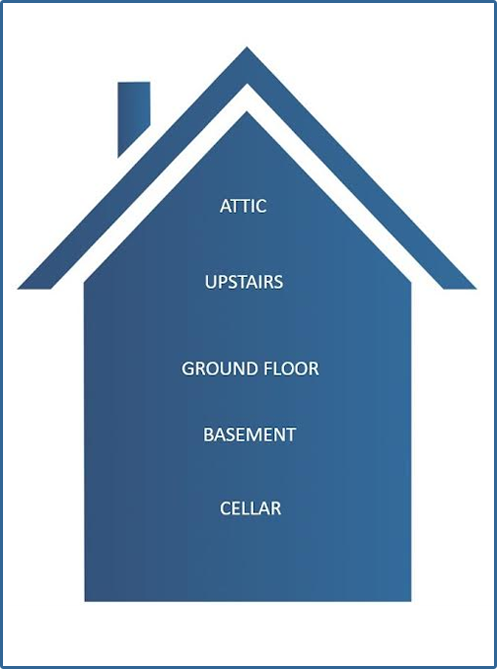
Five Floors. Five States of Mind.
The visual image of a house gives us emotional structure in our emotional worlds where often, we have had no structure before. With this structure you can find where you are emotionally. What floor are you on right now?
The spiral staircase that spins helps us to visualise what is happening when we spiral up and down emotionally.
On the Ground floor the staircase does not spin. Here we are not spiralling up or down. We are focused on what we value, on our purpose in this moment, and in any interaction with another person.
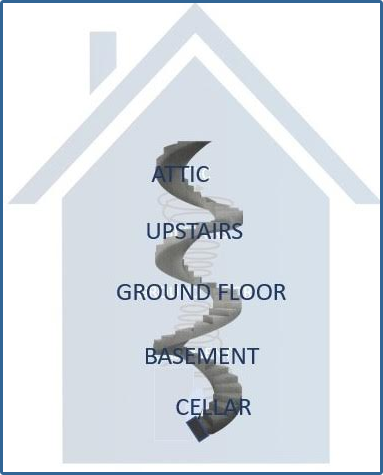
The spiral staircase that spins.
The spiral staircase joins all five floors.
When you spiral up or down emotionally, you have stepped onto the staircase. And when you step onto it, the staircase starts to spin. With each anxious thought, each heavy thought, you take another step — higher or lower.
The staircase spins higher and faster when you spiral upwards into your Upstairs and Attic. It spins lower and slower when you spiral down into your Basement and Cellar. On the Ground Floor, the staircase does not spin.
Can you feel the spin happening in your emotional world? Can you recognise it?
There is something about the spiral that is rarely said out loud.
It is delicious to spin. Yes. Delicious.
Over-thinking, over-stressing, over-worrying — difficult, yes, but also delicious. Thinking “nothing ever works for me” or “what’s the point?” — miserable, yes, but also delicious.
Can you recognise the deliciousness when you spiral up or down? This is important.
When the staircase spins, it generates a real pull. You feel it — the force that holds you in the spiral even when you can see clearly that you are in it. It can get you in its grip and hold you tight. We get stuck. Sometimes we move up and down endlessly, going nowhere.
Your House Within is the same as everyone else’s House Within. But you get to choose which floor you spend your time on.
The House Within shows you how.
Your Ground Floor — a recipe
1. Begin with gratitude and compassion.
Start with something small. I have shoes, I am grateful I have them. Feel it. Don’t just think it. Some people do not have shoes. I feel compassion for them. Genuinely. If you cannot feel gratitude and compassion for simple things, you are not yet on your Ground Floor.
2. Hold your emotions
You will have all the feelings you have on any other floor — but here you can hold them. Feel them fully but not be driven by them. You are in charge of your emotions now.
3. Replace me thinking with we thinking.
Look for a way through — whether it is a difficult situation or a difficult relationship. Don’t be reactive. Don’t spiral. Ask yourself – how can I respond in a way that is good for me and equally good for other people at the same time? Keep this focus even when it is hard.
4. Resist the deliciousness of spiraling.
You will be tempted —remember, it is delicious to spiral up or down. But you are tired of going round and round. Progress only happens on your Ground Floor. If you spiral — you just spin.
5. Get your wheel turning- on this horizontal path.
Start with one step so small you cannot fail to take it. Then another. And another. Give yourself a big tick for each one — this is key and often forgotten. You are building your own momentum.
6. Wait. Options will come.
With gratitude, compassion, we thinking and a little patience — new thoughts will come. Better options than you had before. Options you could not see from the Upstairs or the Basement. Let them in.
7. Have faith.
Faith is a necessary ingredient. You have built it with each small step you have achieved and then acknowledged to yourself. You have seen it work. You are building faith in this process and in yourself that you can achieve meaningful outcomes on your Ground Floor.
COOK'S NOTE
All the steps in this recipe are simple. None of them are easy to begin with. But with practice you will find that making this recipe becomes more and more part of your way of being — within yourself, and in your interactions with others. You are becoming more skilful in your emotional kitchen, on your Ground Floor. You are learning how to resist the urge to spiral up and down. You are learning what it means to feel better about yourself. – It is a good recipe.
Your Ground Floor — a recipe
Begin with gratitude and compassion.
Start with something small. I have shoes, I am grateful I have them. Feel it. Don’t just think it. Some people do not have shoes. I feel compassion for them. Genuinely. If you cannot feel gratitude and compassion for simple things, you are not yet on your Ground Floor.
Hold your emotions
You will have all the feelings you have on any other floor — but here you can hold them. Feel them fully but not be driven by them. You are in charge of your emotions now.
Replace me thinking with we thinking.
Look for a way through — whether it is a difficult situation or a difficult relationship. Don’t be reactive. Don’t spiral. Ask yourself – how can I respond in a way that is good for me and equally good for other people at the same time? Keep this focus even when it is hard.
Resist the deliciousness of spiraling.
You will be tempted —remember, it is delicious to spiral up or down. But you are tired of going round and round. Progress only happens on your Ground Floor. If you spiral — you just spin.
Get your wheel turning- on this horizontal path.
Start with one step so small you cannot fail to take it. Then another. And another. Give yourself a big tick for each one — this is key and often forgotten. You are building your own momentum.
Wait. Options will come.
With gratitude, compassion, we thinking and a little patience — new thoughts will come. Better options than you had before. Options you could not see from the Upstairs or the Basement. Let them in.
Have faith.
Faith is a necessary ingredient. You have built it with each small step you have achieved and then acknowledged to yourself. You have seen it work. You are building faith in this process and in yourself that you can achieve meaningful outcomes on your Ground Floor.
COOK'S NOTE
All the steps in this recipe are simple. None of them are easy to begin with. But with practice you will find that making this recipe becomes more and more part of your way of being — within yourself, and in your interactions with others. You are becoming more skilful in your emotional kitchen, on your Ground Floor. You are learning how to resist the urge to spiral up and down. You are learning what it means to feel better about yourself. – It is a good recipe.
Your House Within and Your relationships
Now you understand how to use The House Within to find your own Ground Floor, you can also use it to build better relationships — at home, at work, at school — with everyone.
When you are ready, explore the relationships page.
Grounded in science. Convergent across traditions
The House Within did not emerge from a single theoretical tradition. It emerged from thirty years of clinical practice — from listening to many people from all walks of life, and all ages and life stages. After developing the framework, it has been important and informative to discover how it converges independently with a remarkable range of scientific and philosophical frameworks. These convergences were not designed. They were discovered. And they provided confirmation of the universal relevance of The House Within approach.