
Your House Within and Your Relationships
Every interaction you have with another person is a relationship.
The conversation with your neighbour at the letterbox. The moment your manager gives you feedback. The phone call with your mother. The argument with your teenager about the dishes. The colleague who always seems to have a problem. The friend who talks endlessly about their stresses. The partner who comes home in a difficult mood.
Every one of these is a relationship. And in every one of them, you bring your House Within.
You bring your five floors. The other person brings theirs. And what happens between you — the ease or the difficulty, the warmth or the friction, the connection or the wall — depends significantly on which floor each of you is on when you interact.
The House Within does not offer a theory of relationships. It offers something more immediate than that. It offers a map of what is actually happening between you and another person, in any moment — and a way of choosing how to respond.

What you bring
When two people interact, each brings their own House Within into the encounter. Their own five floors. Their own staircase.
But something interesting happens in many interactions — and in almost all long-term relationships.
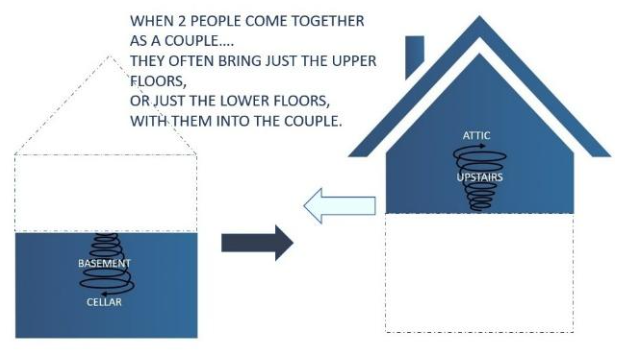
People stop bringing all five floors. Without realising it, they begin to surrender some floors to the other person. One person takes the upper floors — the worrying, the organising, the striving, the anxiety. The other takes the lower floors — the withdrawal, the inertia, the resistance to change. Together they form a single merged house. And the Ground Floor — the only floor where genuine thinking, genuine compassion, and genuine connection are possible — is left empty.
Neither person chose this. It happened gradually, one interaction at a time. Each person slipped into their designated floors because it was easier than maintaining their own complete house. It felt natural. It felt, after a while, like the only way.
You will recognise this dynamic.
“I’m the anxious one. They are laid back.”
“I’m always the one who organises everything. They just come along for the ride.”
“I’m the one who worries about money. They spend without thinking.”
“Mum’s always negative about everything. I have to be the positive one.”
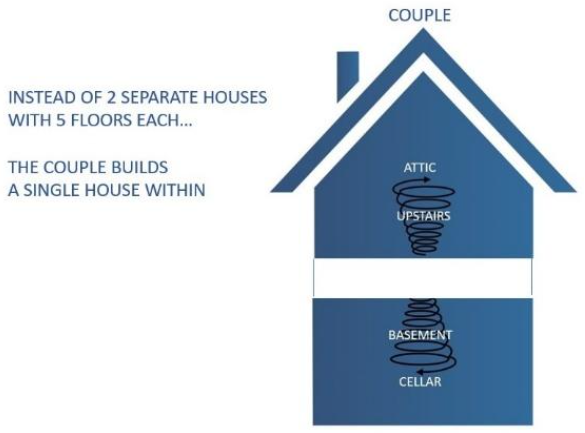
These are not just personality differences. They are two people in vertical balance — one at the top of the house, one at the bottom — each compensating for the other, each reinforcing the other’s position. The system is in balance. But no one is on the Ground Floor.
And a system in vertical balance is fragile. The moment one person decides they no longer want to occupy their designated floors — the moment the anxious one stops anxiously organising, or the withdrawn one stops withdrawing — the whole arrangement becomes unstable. A spinning top eventually falls over.
The only sustainable alternative is for each person to maintain their own separate House Within — all five floors — and to work, as often as possible, from their Ground Floor. Not perfectly. Not always. But to try to be on your Ground floor as much as possible.
This is what The House Within offers in relationships. Not a guarantee of harmony. A map for finding your own Ground Floor first — so that the other person has the best possible chance of finding theirs.
What difference does it make?
Here is the same ordinary moment — a husband coming home from work in a difficult mood — and three different responses. Each one comes from a different floor.
A husband comes home one evening angry and despondent. He shouts at the dog, complains about the bills in the mail, and is critical of the meal his wife has prepared. This is not his usual state of mind.
Response one — from the Upstairs and Basement
The wife feels hurt and unappreciated. She is tired after a long day and takes his comments personally. She cannot think about what might be happening for him. She responds with her own list of complaints and escalates the tension. They don’t talk for the rest of the evening.
She has matched his floor. The merged house is locked in vertical balance — him in the lower floors, her spiralling up. No one on the Ground Floor.
Response two — from the Basement
The wife isn’t confident about her cooking. She needs constant reassurance that what she prepares is good. When he criticises the meal, she collapses inward. She cannot think about him or his needs. She wants him to be her rock. She bursts into tears and goes to bed, slamming the door.
She has fallen to her lower floors. The merged house tips — both now below the Ground Floor. The system falls over.
Response three — from the Ground Floor
The wife feels hurt and unappreciated. She is tired after a long day. But then she remembers — he had an important meeting with his manager today. She wonders if it didn’t go well. She is thinking. She is compassionate. She has found her Ground Floor.
She holds her feelings. When the moment is right, she asks him how the meeting went.
He is a bit gruff at first. But he is appreciative that she remembered. She encourages him to talk. On her Ground Floor she can feel the hurt and still choose how to respond. She is a separate person with her own House Within. His state of mind has not controlled hers.
The most important principle in any interaction
You cannot make another person change what floor they are on.
But if you can find your own Ground Floor — and bring it into the interaction — you give the other person the best possible chance of finding theirs.
This is not a guarantee. Some people will stay on their floor regardless. But the interaction will not improve unless at least one person finds the Ground Floor first. And the only person whose floor you can control is your own.
Reading the play
In football, a good player does not simply react to where the ball is. They read the play — they watch the field, anticipate where the ball is going, and position themselves to respond well before the moment arrives.
You can learn to do the same in your interactions.
Once you understand the five floors, you can begin to read what floor another person is on — quickly, without making a production of it — and use that understanding to choose your response rather than simply react to theirs.
This does not mean analysing people or treating every conversation as a clinical exercise. It means paying a different kind of attention. The kind that gives you more options.
Consider your neighbour Jim.
Jim is always smiling when you see him at the shopping centre. But within moments of stopping to say hello, he has launched into everything that is going wrong in his life. His family troubles. The rising cost of everything. The same conversation, every time. Jim is reliably in his Basement — negative thinking, the lens of lack, the world as a place that is doing things to him rather than a place he has any agency in.
Without any map, you might find yourself drawn into Jim’s Basement without quite knowing how you got there. You nod along. You commiserate. You leave the conversation feeling flat and slightly drained. And next time you see Jim at the shopping centre, you feel a small but distinct reluctance before you say hello.
But you can learn to read the play with Jim.
“Hello Jim, have you seen the new shop opening down the road? Anyway, good to see you — I’d better keep moving.”
Warm. Genuine. Brief. You have stayed on your Ground Floor. You have not let Jim’s state of mind determine which floor you respond from.
Another time you might ask Jim if he could water your plants while you are away, or ask about his bowling club, or mention something you know he cares about. You take the lead. You keep the conversation short but real. You mix it up.
What you are not doing is avoiding Jim, or being cold, or pretending the interaction is something it isn’t. You are simply refusing to let his floor become yours.
Over time you will notice something else. The interactions that once left you drained now leave you feeling quietly good about yourself. That is the Ground Floor reward — not drama, not intensity, just the steady satisfaction of having managed yourself well.

Small steps
Understanding what floor another person is on gives you information. But information alone does not change a relationship. Change requires action — and the action that works best is almost always smaller than you expect.
Consider Sam.
Sam is married with young children. He has always felt that his father relates to him as if he were still a teenager — critical, competitive, quick to find fault. Sam wants something different. He wants a relationship with his father that feels more like two adults who genuinely respect each other. That is his Ground Floor want.
He is not sure his father wants this too. But he decides to try.
He makes an excuse to visit his parents. His father loves to tinker with things in the shed, so Sam brings one of his children’s toys that has broken and asks his father if he can have a look at it. They go out to the shed together. While his father works on the toy, Sam mentions an old memory — the bicycle his father fixed for him when he was young. The toy is repaired. Sam thanks his father with genuine warmth.
One small step. Acknowledged.
A few weeks later Sam asks his father to come and help him cut down a tree branch in his garden. His father is a little hesitant but comes. Sam’s young son Oliver helps clear up the mess. Sam encourages Oliver to work alongside his grandfather. Something shifts, slightly, in the afternoon.
Another small step. Acknowledged.
The next time Sam visits his parents, he notices the side gate is coming off its hinge. He offers to come back the following Saturday to fix it with his father. When he arrives, the gate is already fixed — and his father is grumpy and critical, just like the old days.
Sam does not react. He knows this is how change works. Two steps forward, one step back. He stays on his Ground Floor, has a brief and warm visit, and leaves without drama.
He calls in again a few weeks later. Just to say hello. Just a drink and a short conversation. He heads home feeling more in control of himself than he has in years.
The relationship with his father is changing. Slowly, unevenly, in the way that real change always moves. Sam is not waiting for his father to become a different person. He is simply refusing to keep playing the old roles. He brings his own House Within — all five floors — into every visit. His father’s state of mind does not determine which floor Sam responds from.
He has faith that in time the relationship will find a new shape. And he is right to have that faith, because every small step he takes and acknowledges is evidence that the Ground Floor works.
A few things worth saying before you try this yourself
Expect the reversal. When a relationship begins to change, it will almost always revert briefly to the old pattern. This is not failure. It is the system resisting change before it settles into something new. Hold your Ground Floor through the reversal and continue.
Choose your timing. Some moments are better than others for attempting a new kind of interaction. When the other person is rested, comfortable, not under pressure — those are the moments to try.
Keep the steps very small. Smaller than feels significant. The significance accumulates over time, not in any single exchange.
Acknowledge every movement forward, no matter how small. The acknowledgement is not for the other person. It is for you. It is how you build the faith that the Ground Floor works.
The reward
Managing your emotions in interactions is not easy. It takes more effort than reacting automatically. It requires you to notice what floor you are on, choose a different response, and hold your Ground Floor even when the pull to spiral is strong.
So why do it?
Not because it makes life easier in the short term. It doesn’t. Reacting automatically is far easier. The drama of the spiral — the urgency of the Upstairs, the relief of the Basement, the defiance of the Cellar — is delicious, as we have said. It is magnetic. And the merged house, for all its instability, requires less individual effort than maintaining your own separate House Within.
But the reward of Ground Floor interactions is real, and it accumulates.
You find you have more options. Where before there was one automatic response, now there are several considered ones. That expansion of choice — in the moment, before you speak, before you react — is one of the most quietly significant things the framework offers.
You feel less drained. Interactions that once left you flat — conversations like the ones with Jim, or the morning argument with your teenager, or the committee meeting where nothing changes — begin to feel different. Not because the other person has changed. Because you have.
You feel better about yourself. Not in a grand way. In the way that comes from knowing you managed yourself well — that you stayed on your Ground Floor when the pull was real, that you chose rather than reacted, that you brought your whole House Within into the encounter rather than surrendering it to the merged house.
And occasionally — not always, but enough to matter — the other person finds their Ground Floor too. The husband who came home in a difficult mood opens up when asked how his meeting went. Sam’s father arrives grumpy and leaves having shared a drink. The teenager, after weeks of being met with patience rather than yelling, gets up without being asked.
This is not transformation. It is movement. Small, real, forward movement on the horizontal plane.
“To put everything in balance is good; to put everything in harmony is better.” — Victor Hugo
The merged house is balance — rigid, vertical, easily broken. Separate Houses Within, each person working from their own Ground Floor, is harmony — flexible, sustainable, genuinely alive.
That is what The House Within offers in every interaction you have, with every person in your life.
Our Stories
Mia’s story
Everything on this page becomes clearer in the light of a real situation.
Mia is a young mother pressed against the top of her Attic, furious with a partner who has retreated to his lower floors. She came to counselling having never heard of The House Within. But when the map was placed in front of her, she recognised every floor immediately.
She already knew exactly where she was. She already knew exactly where he was. She had known for a long time.
What she needed was not to be told. What she needed was a structure that confirmed what she already understood — and a Ground Floor to aim for, regardless of what he did or didn’t do.
Natalie’s story
Natalie is a woman who has spent her life inside her father’s emotional world — monitoring his floors, responding to his moods, unable to say no without feeling like a bad daughter. She came to counselling knowing she was exhausted. What she did not know was that she had a Ground Floor of her own, and a strength she had never accessed.
She already knew every floor her father occupied. She had been reading his House Within her whole life. What she had never been given was a map of her own.
What she needed was not to be told what to do. What she needed was to find her own walls — and discover that she could hold her own position calmly, firmly, and without guilt, regardless of what floor her father was on.