
Your House Within
Strategies are great. But why aren't they helping?
People don’t usually come to counselling asking for a map. They don’t ask how their emotions work or say they want to understand what is happening in their emotional worlds.
What they ask for is a strategy. A tool. Sometimes a hack or a trick. The latest thing nobody has told them yet.
They say: I’ve tried journalling. I’ve tried gratitude. I’ve tried breathing exercises. I’ve done CBT. I know about mindfulness.
Do you have any other strategies? Something that might really work, right now?
They are not wrong to ask. It is what the times we live in have taught us to ask. In medicine there is a pill. In counselling there is a strategy. Both promise to make the distress go away. And sometimes they do — for a while.
But what most people are missing is not another strategy.
You can have every ingredient and still not know how to make the cake.
What most people are missing is a living map — a way of understanding what is actually happening in them emotionally, so that the strategies they already have can finally fall into place. The map helps them understand which strategy to use, when it will help, and why.
The House Within offers that map.

A map, not a diagnosis.
The House Within is a way of understanding how your emotions work and how you can learn to manage your emotions differently. It is not about a diagnosis or a label. It is about understanding what happens on each of the five floors and how we can move up or down the spiral staircase to different floors, each of which represents a particular state of mind.
The question The House Within asks is not what is wrong with you? It is where are you? What floor are you on in this moment? That shift — from diagnosis to location, from a label to a floor of a house, that is, a state of mind — is what makes The House Within different. Tune into what you are feeling. Find what floor you are on.
The House Within offers a set of tools and techniques to help you change floors when you want to.
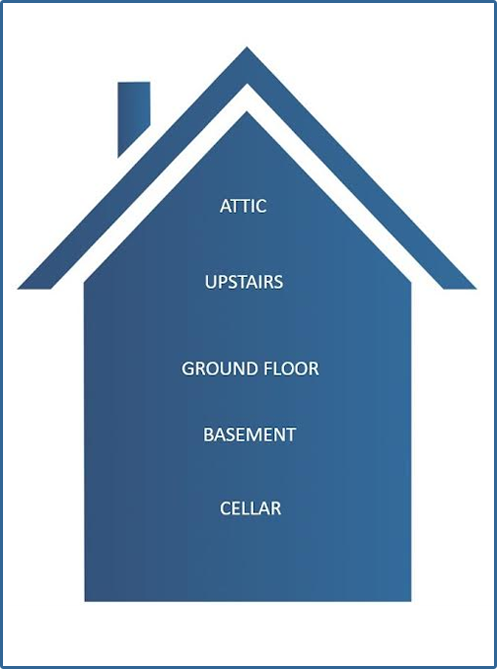
Five Floors. Five States of Mind.
The visual image of a house gives us emotional structure in our emotional worlds where often, we have had no structure before. With this structure you can find where you are emotionally. What floor are you on right now?
The spiral staircase that spins helps us to visualise what is happening when we spiral up and down emotionally.
On the Ground floor the staircase does not spin. Here we are not spiralling up or down. We are focused on what we value, on our purpose in this moment, and in any interaction with another person.
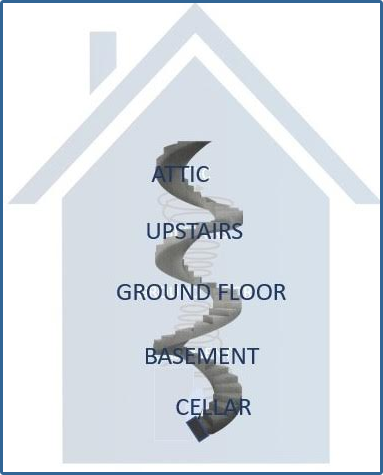
The spiral staircase that spins.
The spiral staircase joins all the five floors.
When you spiral up or down emotionally, you have stepped onto the staircase. And when you step onto it, the staircase starts to spin. With each stirred-up or stirred-down thought, you take another step up or down.
The staircase spins higher and faster when you spiral upwards into your Upstairs and Attic. It spins lower and slower when you spiral down into your Basement and Cellar. On the Ground floor, the staircase does not spin.
Can you see and feel the spin happening in your emotional world?
Here is something important to acknowledge: it is delicious to spin. Over-thinking, over-stressing, over-worrying — difficult, yes, but also delicious. Thinking “nothing ever works for me” or “what’s the point?” — miserable, yes, but also delicious. The deliciousness of spiralling up and down needs to be acknowledged before you can understand and learn to manage your emotional state of mind.
When the staircase spins it generates centrifugal force. This is a real force — we feel it when we are pulled to spiral up or down. Centrifugal force can get you in its grip and hold you tight, making it difficult to change floors. We can get stuck in the upper floors or stuck in the lower floors. Sometimes we move up and down endlessly. The House Within offers a set of tools and techniques to help you change floors.
Your House Within is the same as everyone else’s House Within. But you get to choose which floor you spend your time on.
The House Within and relationships.
Any interaction you have with another person is a couple interaction. That includes marriage partners and de facto relationships, but also parents and children, managers and employees, siblings, friends, colleagues, neighbours, teachers and students, doctors and patients. Every interaction between two people is a couple interaction.
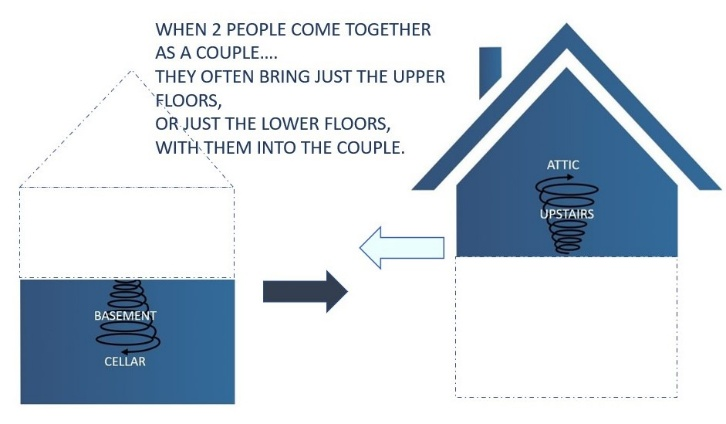
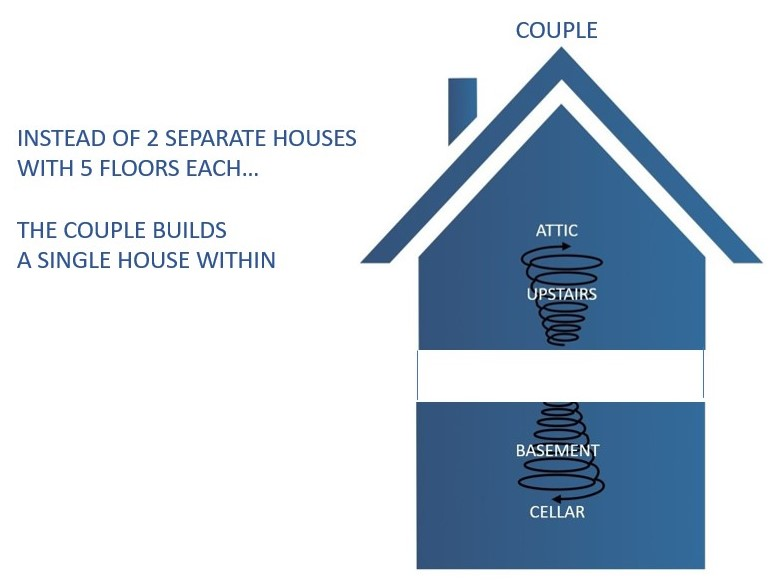
When two people come together, each brings their own House Within — their own five floors — into the interaction. What often happens, however, is that people combine their houses into one House Within. One person brings only their upper floors and the other brings only their lower floors. No-one is on the Ground floor. Sometimes both choose to live in the upper floors or they cohabit in the lower floors.
Together they create a merged House Within, and the Ground floor is left empty. The Ground floor is where relationships have their best chance of working well. In a merged House Within, patterns become fixed and repetitive. One person spirals up; the other spirals down. They balance each other vertically — but it is a rigid balance, easily broken, and costly to both people emotionally.
The only way to change an interaction with another person is to find your own Ground floor first. You cannot make another person change what floor they are on. But if you bring your Ground floor into the interaction — with genuine thinking, gratitude, compassion, and a clear sense of what you want to achieve, something that is good for you, good for the other person, and good for the couple — you give the other person the best possible chance of finding their Ground floor.
This takes effort. Reacting automatically is so much easier. It is delicious. But the reward is real: fewer emotional ups and downs, more options in how you respond, and the quiet accomplishment of knowing you were able to manage your emotions —independently of what the other person did. You have stayed within your values and your sense of meaning and purpose. You feel better about yourself. That’s the reward.
Grounded in science. Convergent across traditions
The House Within did not emerge from a single theoretical tradition. It emerged from thirty years of clinical practice — from listening to many people from all walks of life, and all ages and life stages. After developing the framework, it has been important and informative to discover how it converges independently with a remarkable range of scientific and philosophical frameworks. These convergences were not designed. They were discovered. And they provided confirmation of the universal relevance of The House Within approach.